

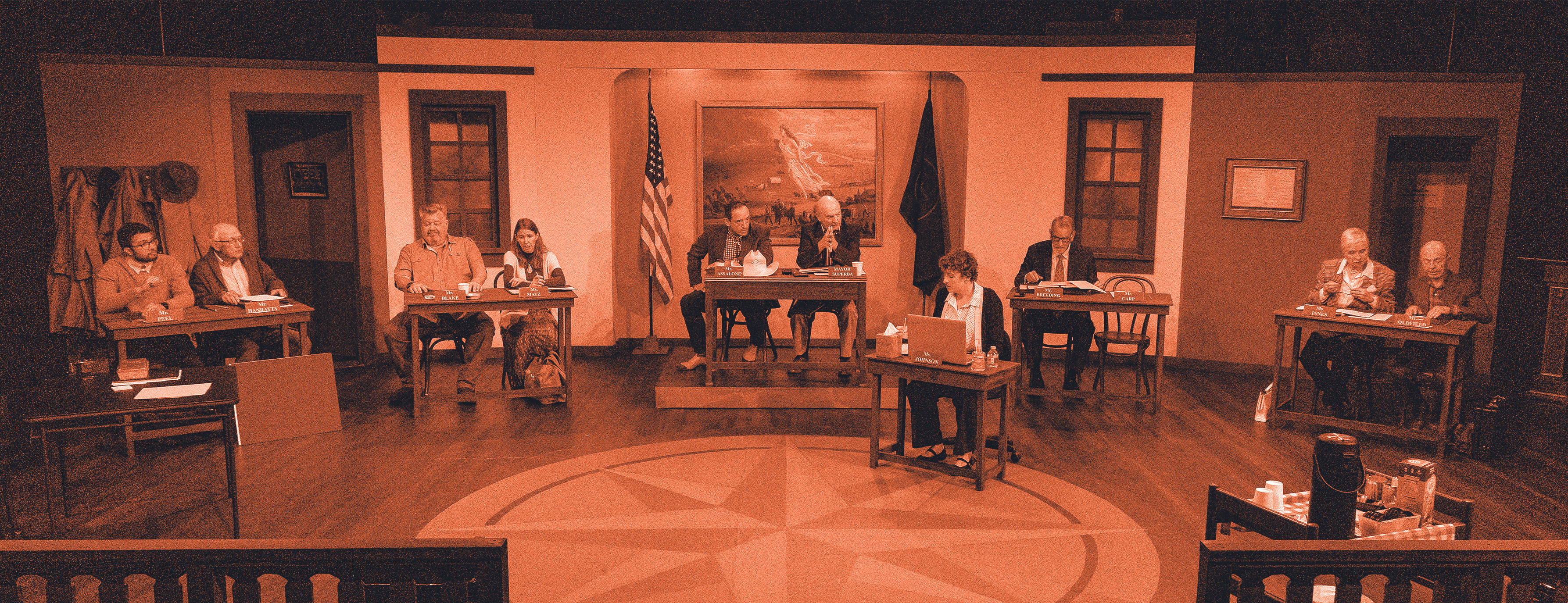
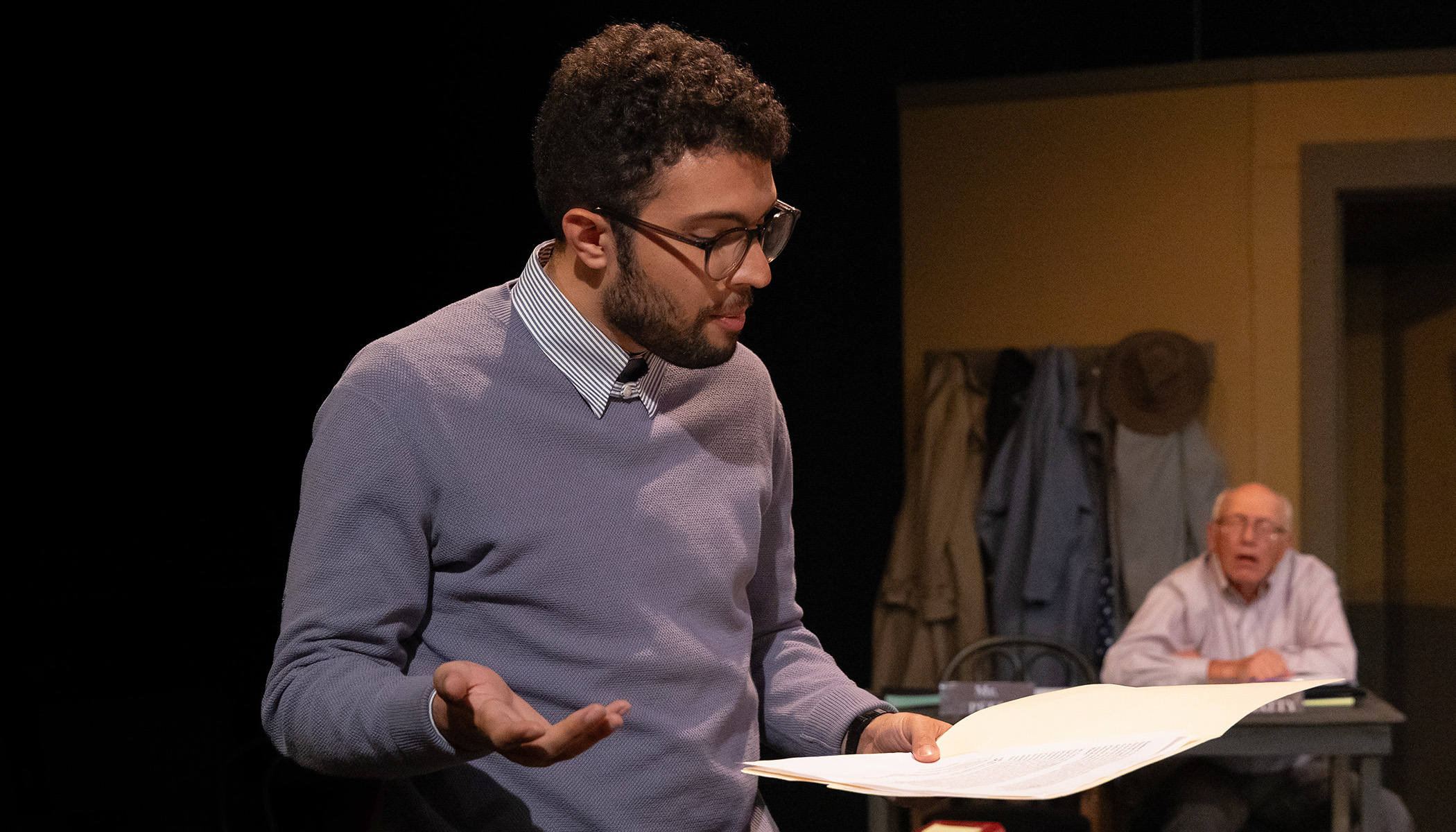
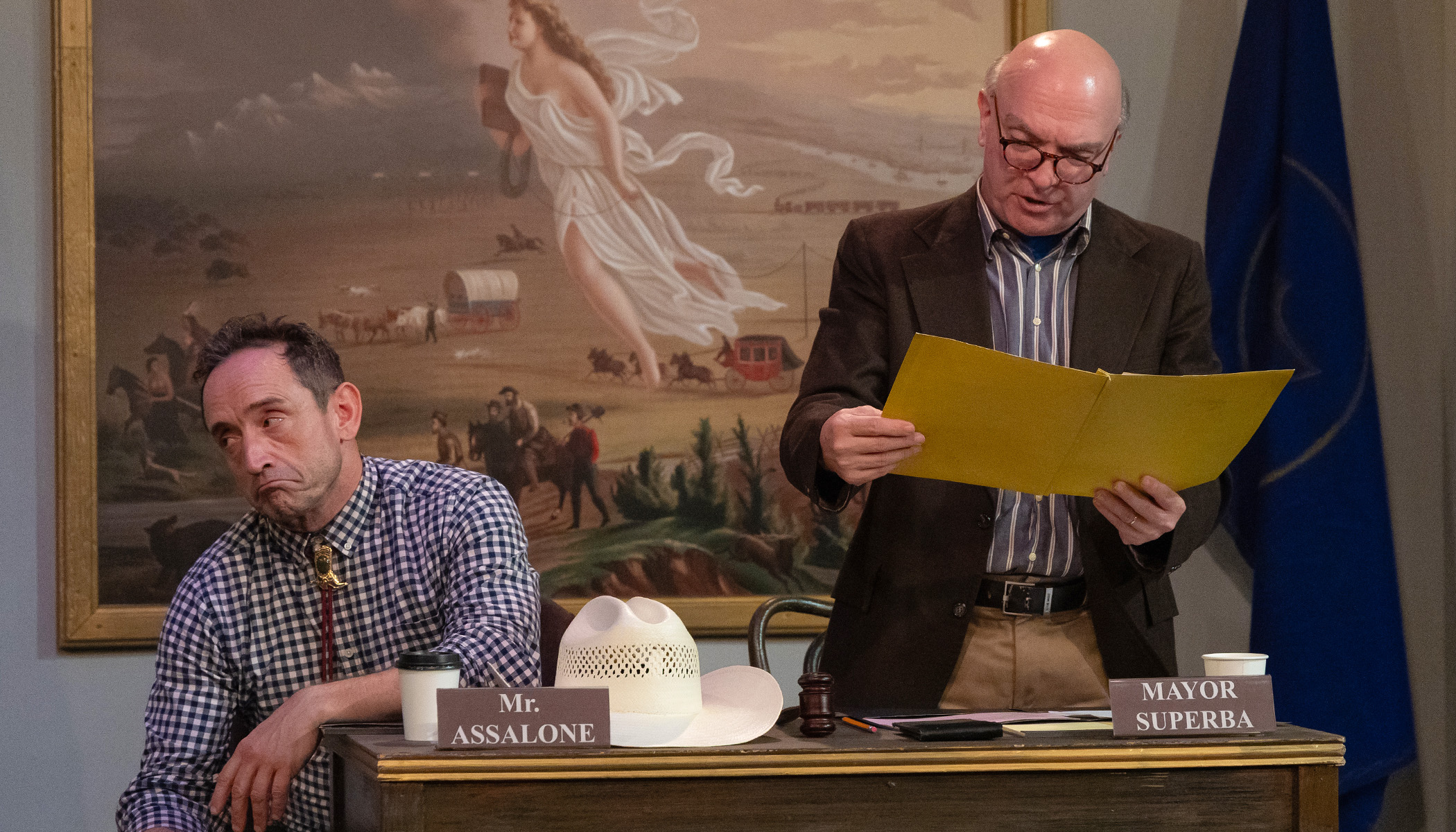
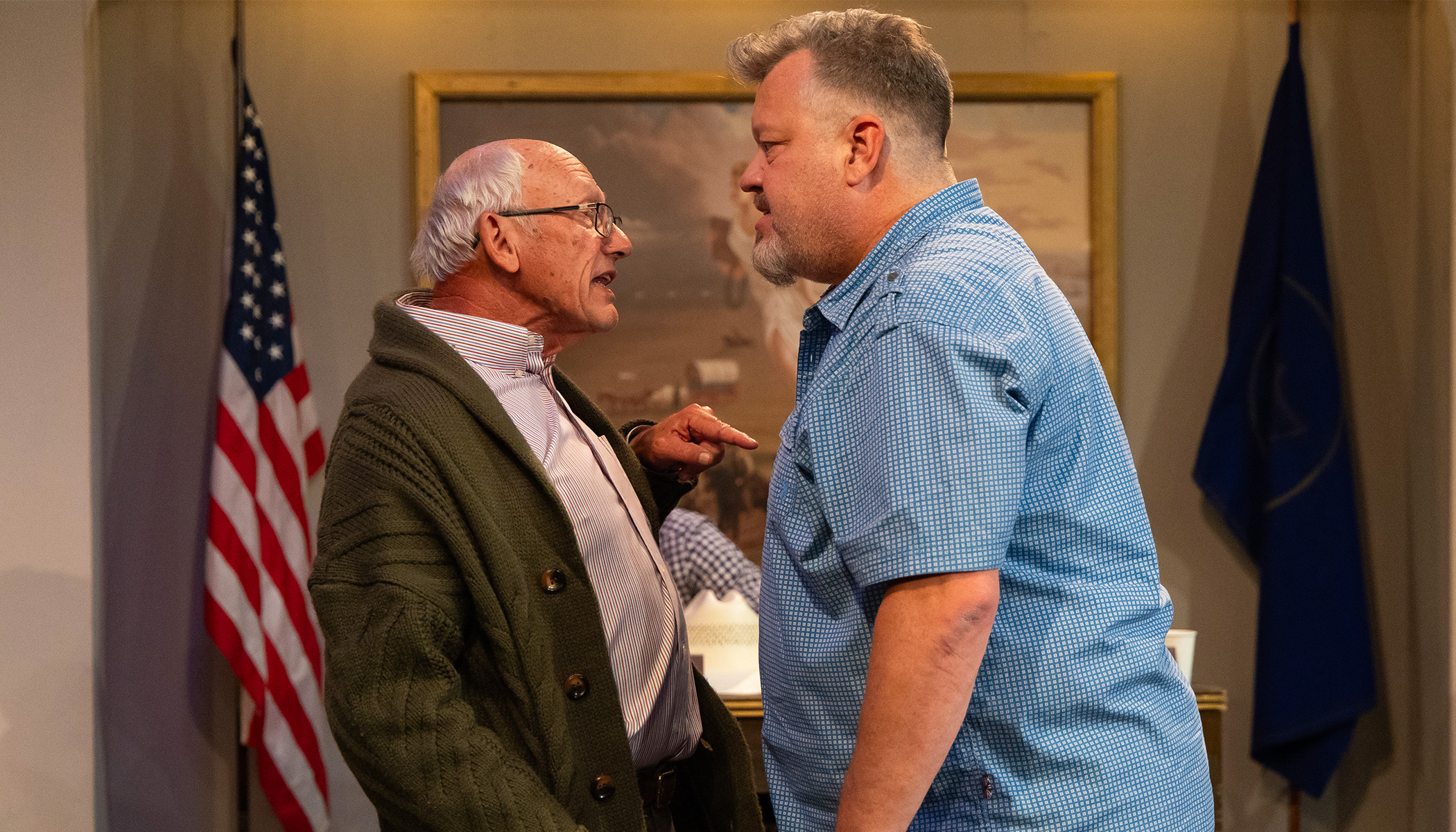
A town’s proud history, the legend of a local hero, the coveted privilege of reserved parking: nothing is sacred during the town council meeting. This razor-sharp comedy turns from hilarious to chilling as petty policy matters give way to the truth roiling just beneath the surface of the town’s historical mythology.
A city council meeting room in Big Cherry; November.
Reservation History of The Spokane Tribe by Warren Seyler
Spokane Tribe 1858 Battles: Steptoe, Four Lakes and Fire on the Plains by Warren Seyler
A Note from the Dramaturg
In 1913, the city government of Spokane moved into a city hall that was supposed to be temporary. The building was modestly designed out of concrete and red brick, located at the southwest corner of Spokane Falls Boulevard and Wall Street, and it was intended to become a warehouse within five years. Instead, it served as the seat of government from 1913 until 1982.
That building, now known as Old City Hall, hosted nearly 70 years of history-making. In 1917, for example, Spokane City Council enacted the law that requires automobiles downtown to be parked parallel to the curb. In 1947, the City of Spokane received a generous trust that enabled the development of Finch Arboretum. In 1977, Spokane Mayor David Rodgers supported the first Lilac Bloomsday Run, helping to inaugurate the city’s beloved tradition. Each of these historic events was recorded and archived within the walls of Old City Hall, in the form of agendas, notices, dockets, and meeting minutes.
Old City Hall is now recognized in the National Register of Historic Places, an official list made by the U.S. Government to distinguish historic properties worthy of preservation. Though the city government shifted its offices elsewhere in 1982, the building is largely unaltered to this day and remains much the same as it was built. In this sense, the collective memory of our city manifests in concrete and brick, but it is legitimized through written records. The city’s stories are given power on paper.
Some of the city’s stories, certainly. For if the granite plinths of Old City Hall could speak, they might whisper words that were long ago struck from the record. The masonry might echo back voices that fought and failed to be heard. The Minutes asks us to grapple with these overlapping narratives — the selective memories and shared mythologies that construct our community. If the very ground beneath city hall could recall our past, whose tales might it tell?
Indeed, only some stories are destined to become official, written histories. Many others will be left outside the archive, in the rain.
Kaya Mallick, Dramaturg
A Historian’s Critique
Twenty years ago, Tracy Letts wrote August: Osage County, a play with one Native character in it, Johnna Monevata (Cheyenne). Johnna is on stage for much of the play but speaks little, mostly bearing witness to a series of family melodramas. Ten years ago, Letts wrote The Minutes, a play with no Native characters in it but which does include a recounting of one fictionalized Native oral history. As an audience member and a Native person, I’m not sure which option is better and which is worse.
The Minutes is not a play centered on Native people or Native history, but Letts did write (inaccurate) Native history into the play, and I think that merits discussion. The Minutes invokes histories of the Sand Creek Massacre of 1864 and the Wounded Knee Massacre in 1890, but it does not name either of them. For Native people, these histories are open wounds, reminders of the violence the United States wrought in the name of Manifest Destiny. Letts generalizes this history to serve as the town’s founding narrative, except in Big Cherry, the massacre is described as an evenly matched battle between “civilized” settlers and “uncivilized” Native people. In this respect, the play infuriates me. It amplifies the worst 20th century practices of historical erasure in a 21st century moment when school boards and legislatures across the country have enacted policies limiting history education to single perspective narratives. Letts may believe he is satirizing the town council for their refusal to confront the past, but they are the only characters on stage. In the process of satirizing them, he makes them triumphant; they represent the power of American institutions. Satire only works if audiences recognize it, if they understand the work as critiquing characters and actions rather than endorsing them.
In conversations I’ve had about ways Native Americans are portrayed in American theater, theater-goers often assert they have no expectation that authors are representing Native histories or experiences accurately. American theater has trained audiences to expect less from playwrights. Letts may be aware of these audience expectations and perhaps he decided to meet audiences where they are—he fictionalized Native history in The Minutes and he is rewarded for that decision with every ticket purchased. But I wonder if accuracy wouldn’t be more rewarding for both playwrights and audiences? Historical falsehoods are tidier and more digestible in the mainstream but the complexities within our shared past tell us far more interesting stories.
Laurie Arnold, PhD (Sinixt Band, Colville Confederated Tribes)
FUN FACTS
- Legally Blonde: The Musical premiered on Broadway at the Palace Theatre on April 29, 2007, and ran for 595 performances. It was nominated for several Tony Awards, including Best Original Score and Best Leading Actress in a Musical for Laura Bell Bundy (Elle Woods).
- The musical is based on the 2001 film Legally Blonde starring Reese Witherspoon. However, it adds new songs, characters, and plot elements that are unique to the stage adaptation.
- Beyond its comedic elements, the musical explores themes of empowerment, self-discovery, and the importance of staying true to oneself. It’s known for its upbeat and positive message.
- The musical has been performed in numerous countries around the world, including the United Kingdom, Australia, Canada, South Korea, and Japan, among others. It has been translated in several languages, adapting the story for different cultures.
Archival Photos by Marlee Melinda Andrews