


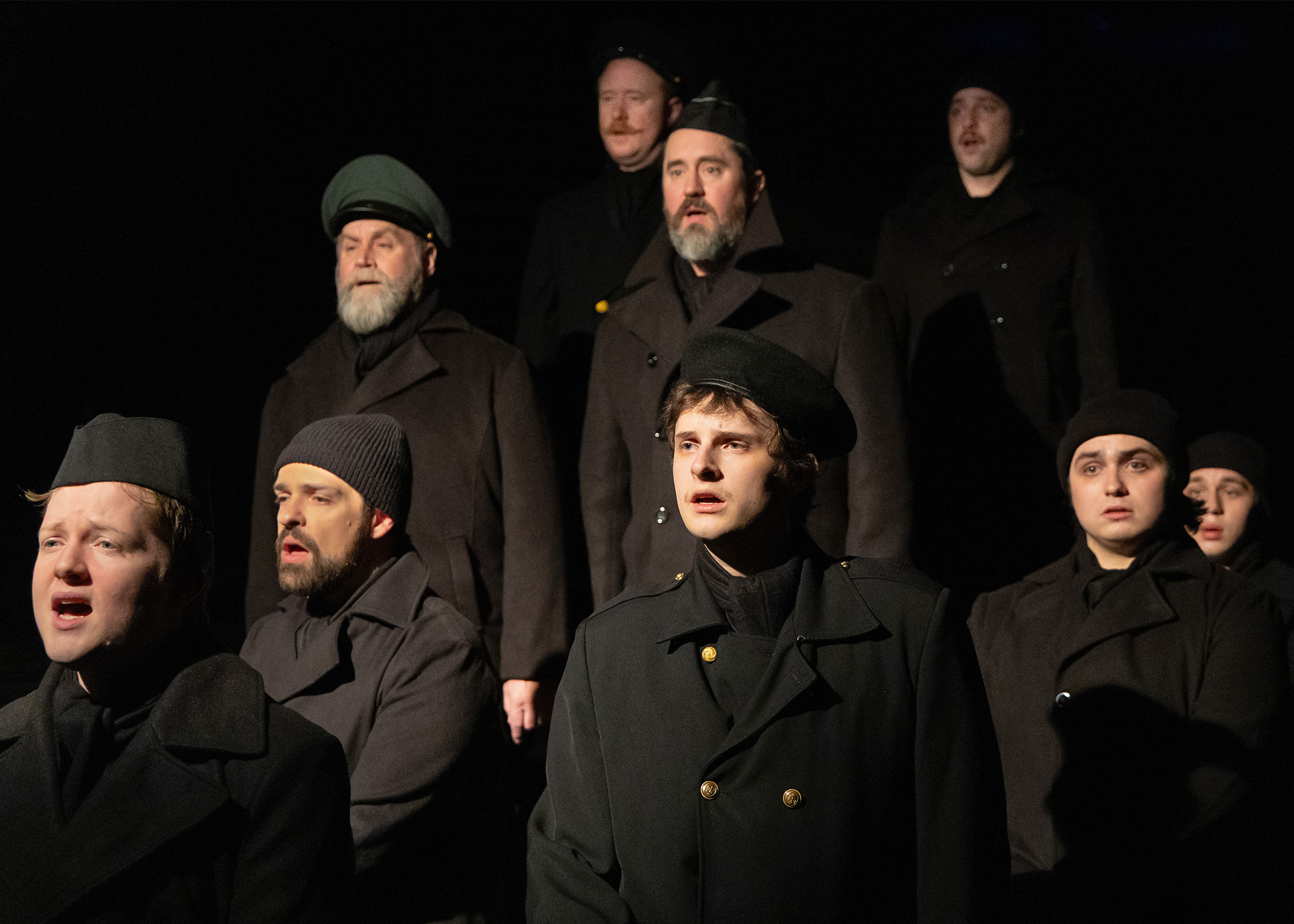
On a cold winter night on the Western Front of the First World War, a pause in the violence, a silence, then a song. A German soldier steps into No Man’s Land singing “Stille Nacht” beginning an extraordinary night of camaraderie, music, and peace. All Is Calm tells the true story of this remarkable night through exquisite arrangements of traditional carols and actual words from letters, diaries, and first-person accounts of the men who lived through it.
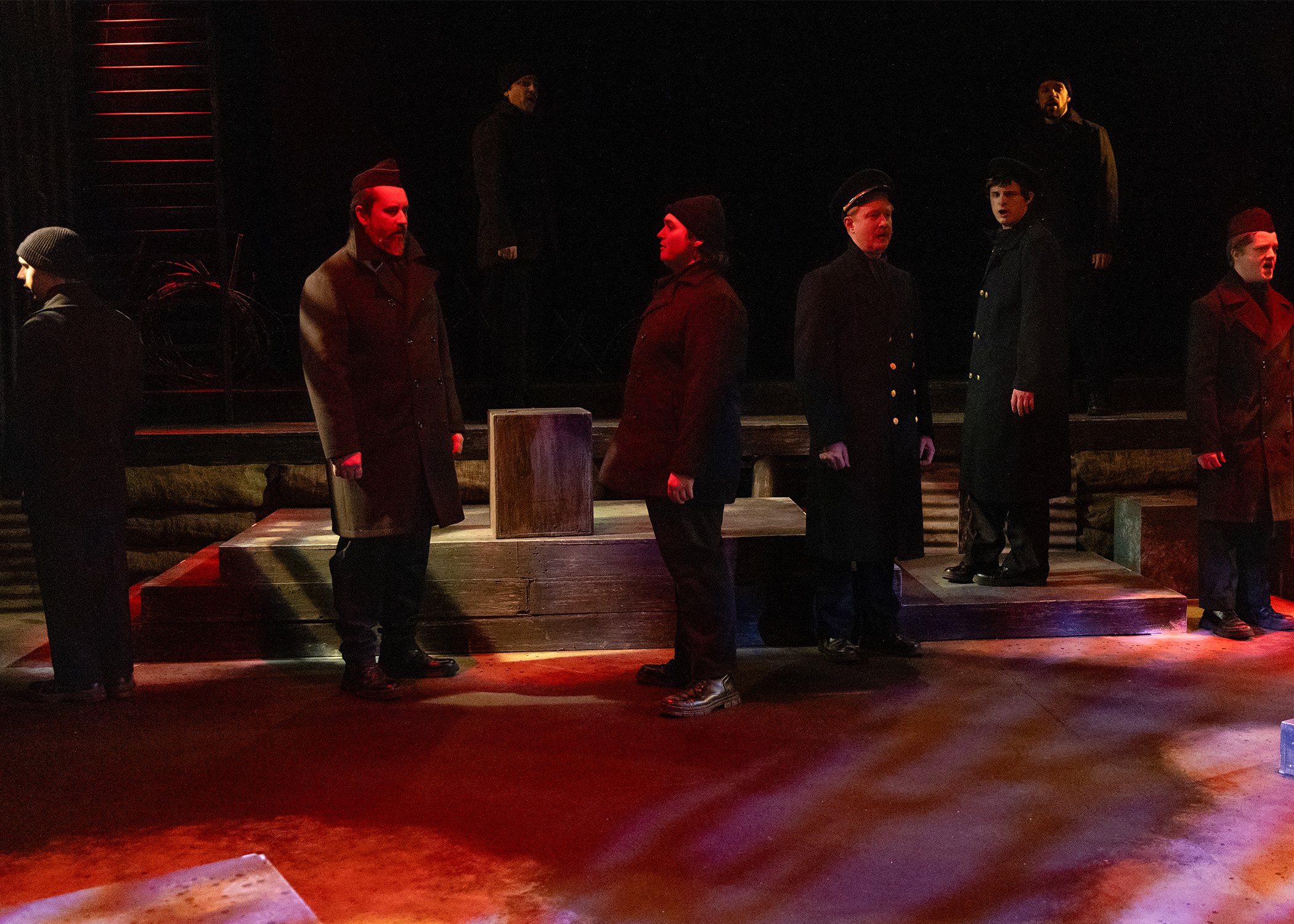
No Man’s Land, December 24, 1914. No Man’s Land was located on the Western Front between Belgium and northeastern France. The width varied, often being between 100 and 300 yards, but sometimes shrinking to just a few dozen yards or widening considerably depending on the terrain and specific location.
The Great War Begins
World War I, otherwise known as The Great War, began in 1914 after the assassination of Archduke Franz Ferdinand of Austria. His murder catapulted into a war across Europe that lasted until 1918. During the four-year conflict, Germany, Austria-Hungary, Bulgaria and the Ottoman Empire (the Central Powers) fought against Great Britain, France, Russia, Italy, Romania, Canada, Japan and the United States (the Allied Powers). Thanks to new military technologies and the horrors of trench warfare, World War I saw unprecedented levels of carnage and destruction. By the time the war was over and the Allied Powers had won, more than 16 million people—soldiers and civilians alike—were dead.
The Christmas Truce
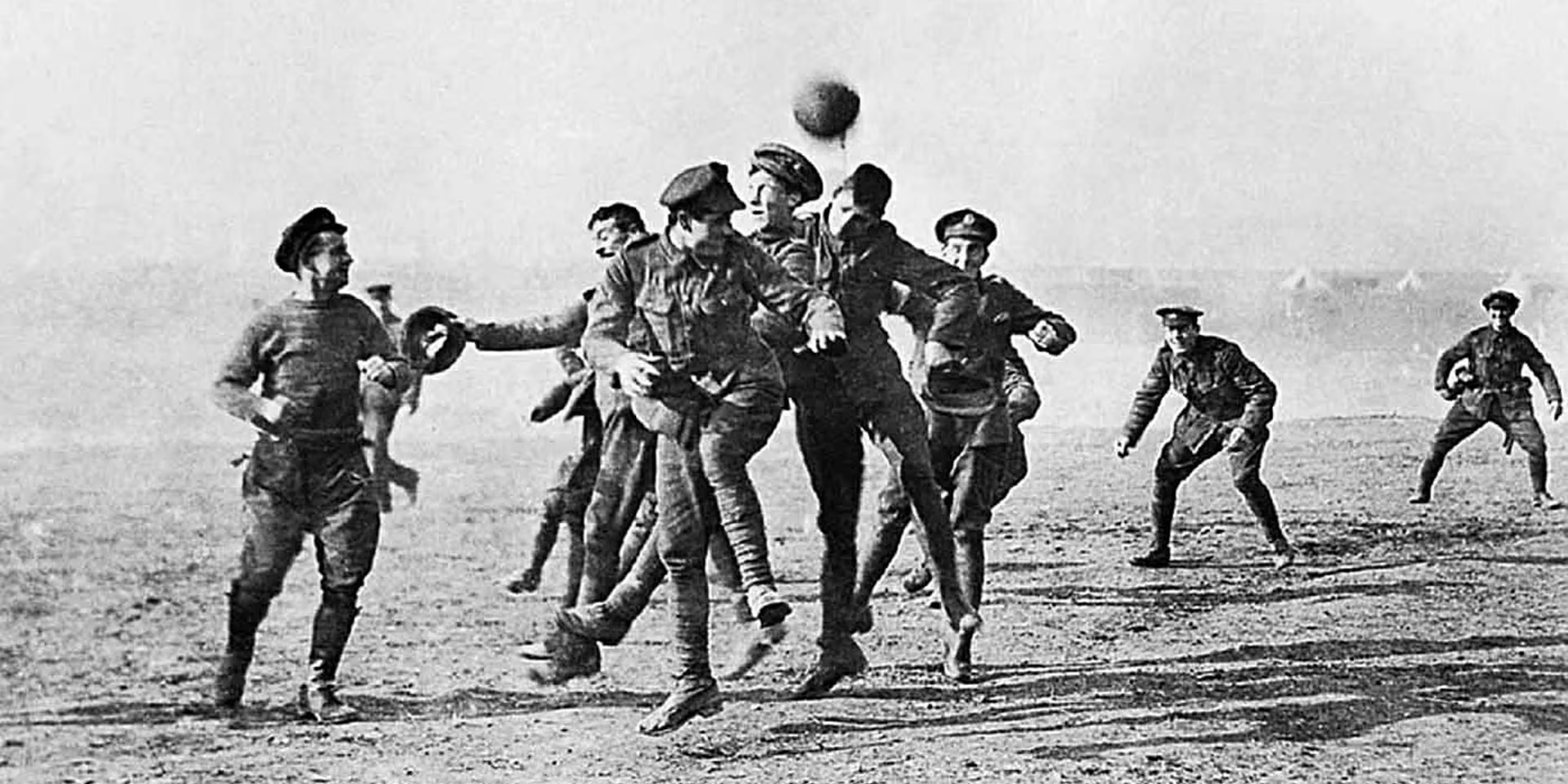
Within the first year of WWI, the soldiers believed that they would be home by Christmas. Unfortunately, this wasn’t the case. British machine gunner Bruce Bairnsfather, later a prominent cartoonist, wrote about it in his memoirs. At about 10 p.m., Bairnsfather noticed a noise. “I listened,” he recalled. “Away across the field, among the dark shadows beyond, I could hear the murmur of voices.” He turned to a fellow soldier in his trench and said, “Do you hear the Boches [Germans] kicking up that racket over there?” “Yes,” came the reply. “They’ve been at it some time!”
The Germans were singing carols, as it was Christmas Eve. In the darkness, some of the British soldiers began to sing back. “Suddenly,” Bairnsfather recalled, “we heard a confused shouting from the other side. We all stopped to listen. The shout came again.” The voice was from an enemy soldier, speaking in English with a strong German accent. He was saying, “Come over here.” One of the British sergeants answered: “You come half-way. I come half-way.”
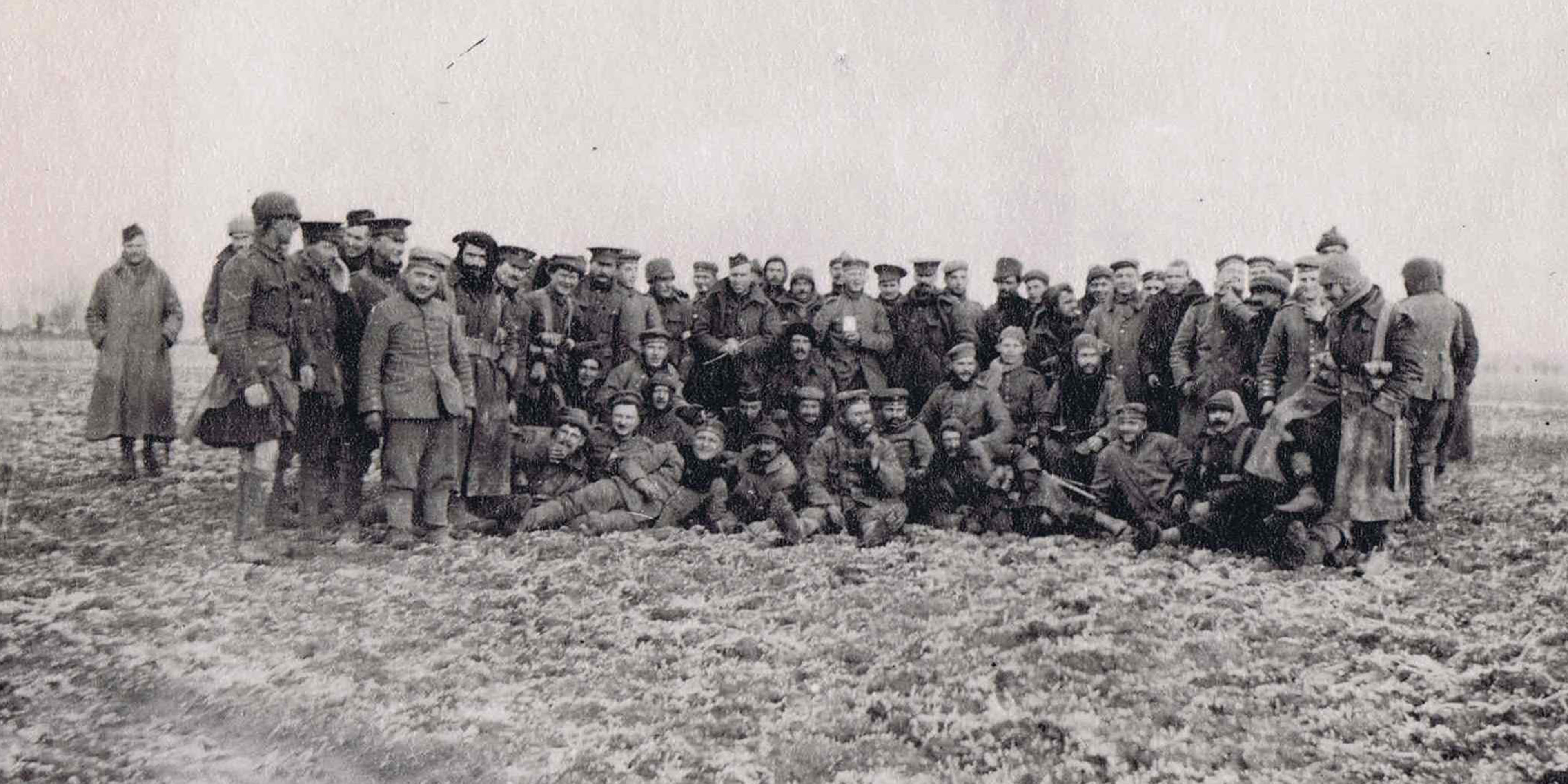
What happened next would, in the years to come, stun the world and make history. Enemy soldiers began to climb nervously out of their trenches, and to meet in the barbed-wire-filled “No Man’s Land” that separated the armies. Normally, the British and Germans communicated across No Man’s Land with streaking bullets, with only occasional gentlemanly allowances to collect the dead unmolested. But now, there were handshakes and words of kindness. The soldiers traded songs, tobacco and wine, joining in a spontaneous holiday party in the cold night.
The Real People
Throughout All Is Calm, performers cite actual letters that were written by first-hand witnesses to the Christmas Truce. Not only reading from the soldiers who were there, but also big names from history that were watching from afar such as Pope Benedict XV and Winston Churchill.
The names of the real soldiers that are cited are:
Dick Barron, 2nd London Mounted Brigade
Private Frank Bass, 9th Battalion Norfolk Regiment
Andrew Bowie, Queens Own Cameron Highlanders
Robert Burns, 7th Queens Own Cameron Highlanders
Captain A D Chater, 2nd Battalion Gordon Highlanders
Private W.T. Colyer, Artists’ Rifles
Lance Corporal Coulson, London Rifle Brigade
Cyril Drummond, Royal Field Artillery
Corporal John Fergusen, Seaforth Highlanders
General Sir John French, British Expeditionary Force
Count Gleichen, Brigadeir General, 15th Brigade
Captain Sir Edward Hulse, Scots Guard
Hugo Klemm, 133rd Saxon Regiment
Maurice Laurentin, commandant 6e compagnie
Francis Edward Ledwidge, Royal Inniskilling Fusiliers
Geoffrey Lillywhite, Royal Engineers
George Littlefair, Durham Light Infantry
Private Tom Macdonald, 9th Batalion Royal Sussex Regiment
Patrick MacGill, London Irish Regiment
Lt. General C.F.N. Macready, British Army
Private Peter McGregor, 14th Battalion Argyle and Sutherland Highlanders
Albert Moren, 2nd Queen’s Regiment
Sgt. G.H. Morgan, Royal Warwickshire Regiment
Oberstleutant Johannes Niemann, 133rd Royal Saxon Regiment
Wilfred Owen, Manchester Regiment
Second Lieutenant Arthur Pelham-Burn, 6 Gordon Highlanders
Private W.R.M. Percy, London Rifle Brigade
Private Edward Roe, East Lancashire Regiments
Jack Rogers, Sherwood Foresters
Siegfried Sassoon, Royal Welch Fusiliers
Captain Joseph Seward, 17th Bavarian Regiment
Private Frank Sumpter, London Rifle Brigade
Private Jack Sweeney, 1st Batallion, Lincolnshire Regiment
G.T. Forrestier-Walker, Brigadier General
H.G.R. Williams, London Rifle Brigade
Henry Williamson, London Rifle Brigade
Frank and Maurice Wray, London Rifle Brigade
Pages to Stages
Using letters and recorded instances from various sources, the story of The Christmas Truce was brought to the stage in 2007. Peter Rothstein (writer of All Is Calm), states he studied World War I in high school and college, but didn’t remember reading about the Christmas Truce in any of his textbooks. In 2005, he attended a Cantus Christmas concert. He was struck by not only their remarkable sound, but also how their work was pushing the boundaries of chamber music in the ways Theater Latté Da was pushing the boundaries of musical theater. Rothstein then approached Cantus about collaborating on a piece about the Christmas Truce. They immediately said yes, and their work began.
All Is Calm was developed and produced by Cantus and Theater Latté Da in Minneapolis, Minnesota, in December 2007 to critical acclaim. The production is performed regularly throughout the country and is loved by thousands to this day.
Rothstein writes “One of the reasons I love working in theater, versus film or television, is because the theater is a two-way street. It asks the audience to engage their imagination in order to complete the story. So, here are the words and songs of these remarkable men. Completing the story, putting a human face on war — well, that’s up to you.”
We. Will. Remember. Them.
Of all the shows I’ve ever been a part of, All Is Calm holds the biggest piece of my heart. It has been nine years since I had the honor of directing it last, and it hasn’t lost any of its power. I am ever so grateful to be back at the helm – to be given the opportunity to tell the story again.
In my humble opinion, this show is as important as it is beautiful. I think it is a perfect reminder of compassion, empathy and believing in the goodwill of men.
These humans, these men – reached across the trenches during a bloody war they did not start. They sang songs, celebrated and willingly created comfort and nostalgia with their so-called enemies. They did the impossible.
I think in the dark of that night, with the stars twinkling above, they realized they were sent to this desolate place by leaders who cared nothing for them. So, they chose to create a home and invite each other in for the sake of sanity & peace.
I share this story as often as possible – because I think it depicts parts of human condition as clearly as possible: We were made to love – not hate.
I know this show will touch you deeply, as it has all of us. I am thankful that you are here, to bear witness & remember.
Thank you.
– Abbey Crawford (Director)
Archival Photos by Marlee Melinda Andrews